
My Blog
My thoughts and ideas in words and visuals.

Sona
The story of a man, his son, and their donkey.
The story of a man, his son, and their donkey.
With their donkey, the father and son traveled through a village. They heard a man say,
Look at these fools, they have a donkey, but they walk on feet
Both of them decided it was a good idea to sit on the donkey. Now, the villagers criticized,
How can they be so cruel to make the donkey carry both of them?

The man felt sorry and got off. A passerby said,
What a lazy boy, he lets his father walk while he rides on the donkey.

They changed places as the son felt sorry. A woman remarked,
He should feel ashamed to let his son walk in the hot sun.

They were fed up and started carrying the donkey. People laughed and exclaimed,
Don’t know who the donkey is!

What do you think?
Should they go back to square one?

I very much relate to this story.
When I went to high school in the nearby town, neighbours said
“For a girl it’s enough to attend the government school nearby.”
When I turned 18, relatives said
“It's good to get her married.”
When I began my career, people told
“Its not safe to travel to another state for a job.”
When I took a break for a few years, people criticized
“What a waste of an engineering seat and a gold medal, it would have been better utilized by a man.”
When I returned to work, people asked
“Why don't you focus on your family?”
Now that I run a startup, they question
“Why have you left a high-paying job?”
I'm certain that each of us has encountered similar scenarios. How have you dealt with them?

Sona
The secret is to work less as individuals and more as a team.
A meal delivery startup serves us daily. Often, essential items like rice, rotis, or vegetables are omitted from the delivery. When this happens, our team reaches out to the manager who then arranges for the missing items to be delivered.
Recently, I encountered the delivery guy and asked him
‘Can you check the number of boxes during delivery?’
He replied
‘Sorry, that's not my responsibility. My job is to just deliver the boxes labeled with the name "Sivi" and collect the previous day's boxes. You may want to speak to the packing department.’
He doesn't see the bigger picture of ensuring complete and accurate deliveries. This is the problem with teams working in silos where individuals focus on their own tasks, rather than working collaboratively to achieve a common goal.
"The secret is to work less as individuals and more as a team. As a coach, I play not my eleven best, but my best eleven." says Knute Rockne.
I feel fortunate to have a great team at Sivi that recognizes the value of teamwork in achieving success.

Sona
My kid’s star reward experience
I had this problem, “My son is not listening to me.” I think most parents have this problem. As we all know, kids feel listening or following rules is against their free will.
The possible solutions seemed to be
Don’t order
Give choices
etc.
But, it still didn’t solve my problem. I realized that there is something wrong with the problem. Why do I want him to listen to me? My actual problem is that I’m getting annoyed with some of his behaviors. The solutions to it are radically different now.
Appreciate good behavior
Use a reward system
So, when my son turned 8, I created a reward chart for him and said every time he behaves well he would get some stars on it. And once he earns a thousand stars he would get a reward for it. He got excited to play the game.
We both discussed and decided the game rules such as what sort of behaviors would get him stars, negative stars whenever he misbehaved, etc. He started off with great enthusiasm and motivation. It meant so much to him that he even wrote good luck to himself on the chart.
It took him 8 months to earn those 1000 stars. I asked him to think and let me know what he would like to get as a reward. He loves outdoor cycling and so he wanted to replace his old bike.
Though star rewards are quite common, the additions such as
the rule-setting with him
the longer duration
the one-time reward that’s related to his favorite activity
the negative stars etc.
have made a huge impact.
It not only solved my problem but also resulted in added benefits.
He understood the value of hard work every time he earned stars.
He accepted the consequences of misbehaving whenever he lost his hard-earned stars.
He learned to be patient when he had to wait for his reward.
He appreciated the importance of savings when he finally got his reward.
Now, every time he rides his bike, I can see the pride on his face.
“He did not get his bike, he earned it!”
He enjoyed it so much that he spoke about his star reward experience in the English recitation competition held at his school.
Would love to know if you have had this problem and what have you done to solve it.

Sona
How to tackle the client/stakeholder’s funny comments:
I’m looking for some jazzy UX.
The design looks simple. Can we make it more beautiful?
This is good, but can you change the color?
I did this in PowerPoint. Can you make your design look like this?
Heard these before? Are you smiling? You must be a designer.
Every now and then, we designers hear one or more comments like these from the clients or the stakeholders. There were times I used to get annoyed when I heard those kinds of comments. But things got changed when the thought occurred to me that “We empathize with the users. But, why not with the stakeholders?”. They too work for the greater good of what we build. When they comment on the design, however generic or worse they may be, shouldn’t we try to find the actual reason behind it?
Here are some techniques that I used to tackle those and turn them into meaningful design inputs.
Ask why

In one of the projects, my team designed a map view to show the percentage of growth in every cluster. We used a subtle color for the map and indicated the growth with red and green bubbles of various sizes. It clearly helped the business users understand the distribution within seconds and the design looked elegant. But, one of the business heads said
The design is not good. Color-code the clusters instead of bubbles.
Only when we asked for the reason we found that the cluster demarcation is not clear enough.
Find a middle ground

In one of the workflows that we designed, we kept the fine-tuning of input variables in the first fold and onSubmit scrolled to the second fold to display the processed results. But, the client insisted on dividing the screen into two halves, keeping the fine-tuning on the left and the results on the right. But, the designers were against the idea as the number of input variables was more. It would result in having a horizontal scroll in both halves and make the UI extremely busy.
Considering the usability and the reason behind the suggestion, we then suggested a solution where the fine-tuning will happen on the first page. And onSubmit, the user will be navigated to the results page where the results and the details of the modified variables will be shown in two halves.
Ask for inspirations

Sometimes it happens that the stakeholders and the designers talk about two different things. Once a conversation was going nowhere as one of the stakeholders kept on saying the design is not up to the mark. We then asked him to provide an example to help understand the problem. Only then we found out that he was talking about micro-interactions.
Provide options

We kept the UI as simple as possible as the application that we designed had a lot of forms with a complex workflow. But, the client said,
The UI looks boring, can you make it jazzy?
Even though we made enhancements to the UI without affecting the usability, they were not happy with it. So we provided an additional option and presented them with the A/B results.
Show high-fidelity designs

During the early stage of one of the projects, we did the wireframe and shared that with the client to discuss and get feedback on the user flow. They rejected it saying
The design is not good, this is not the expected UX.
After a few back-and-forth discussions, we understood that they were talking about the UI. So, we decided to do the high-fidelity design and then shared that. Finally, they were happy and gave a go-ahead.
"What looks beautiful feels usable."
Would love to know if you have come across similar situations and how you tackled them.

Sona
Is Sadhguru a yogi or a designer?
The Isha yoga center located amidst the Velliangiri mountains near Coimbatore, Tamil Nadu, is one of the best examples of a well-thought-out design.
Right from the main entrance to the bathroom latches, everything has been designed so well that they are not only simple and beautiful but also provide a great experience.
I was awestruck at every single thing that I saw; the scenic background added by the mountains, the clear navigation cues, the noise-free vehicles and lanes for bikes and scooters, the doors and furniture that reflect the tradition, the dome that covers the sanctum sanctorum of the Dyanalinga, and the list goes on. Above all the food and the peaceful stay… It’s absolute serenity!
No one was told to maintain silence; still, one could sense the calmness amidst the huge headcount.
People were not asked to wash their plates after the meal; still, everyone did.
Though visitors were advised to wear the Indian style of clothing for their own comfort and as a sign of respect for the local culture, they were not forced to do so. Still, they followed.
After seeing all these, this thought struck me.
“Is Sadhguru a yogi or a designer?”
He should have built it with all his heart and soul.
According to Sadhguru, yoga is all about having a designer life.
“It is my wish and my blessing that every one of you should design your own destiny.” —Sadhguru
He sure has designed his!

Sona
Product Designer Interaction With Stakeholders
Collaboration is key to Product Designers day in and day out. Here’s how most of the interaction would be with the different stakeholders across the team.

Sona
Sunday morning at a small, yet busy crockery store
A stout lady, of age around 40, bought crockery for Rs.1300. The store owner who was handling multiple customers handed her the items and asked for money.
She created a scene shouting “I just now gave you Rs.2000. Give me back Rs.700.”
Though no one was sure about that, some of the customers suggested checking whether he has any Rs.2000 note. He genuinely said that he got so many Rs.2000 notes since morning. After 5 min of chaos, he decided to get rid of her and gave her Rs.700.
Once she left, a concerned old man asked him why he did that.
He said, “Sir, I don’t want to spoil my whole day because of this one incident. I still don’t remember whether she gave me the money, but, I’ll take this as a lesson.”
He could have got angry and fought back with the lady. But, he chose not to be affected by it and learn from it.
Sona
Subtleties are equally powerful as hustle: Interaction Design
In the world of explicit expressions, we forget subtleties also have value. Hustle has become a de-facto for expression and this form of expression would push an idea or a sale. Honestly, how many of us like someone pushing their ideas? If we show a subtle expression or a nudge, the chances that people listen to us would be high. The psychology behind this is, we value self-decision-making much more than forced decision-making. Subtle expressions provide a hint or create a question in their mind, still, they are making the decisions.
Last week at one of the zero-tolerance junctions in Bangalore, a bus stopped a few feet past the bus stop. A middle-aged woman and an old lady got down from the bus. They tried to reach the footpath. But, found it tough as the 2 wheelers were going past the bus through the gap between the bus and the footpath. So, they just waited and watched the two-wheelers. Seeing them waiting, one of the riders stopped his two-wheeler and gestured for them to cross. The lady in return smiled at him with a like. He nodded and smiled back.
The interaction was so subtle, yet the communication was effective and it made both parties feel good. The same is the case with interaction design. Most of the time, nuances contribute to effective communication, easy understanding, and efficient use. They are critical for a memorable experience.
We love Art because of its subtleties. Here are a few well-known examples of Digital experiences:
Subtlety in status:
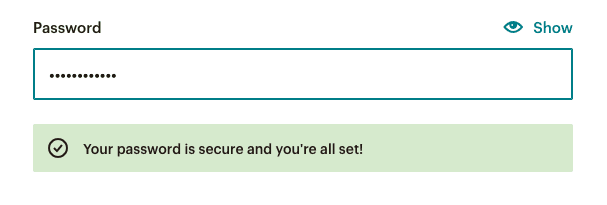
As and when the user types the password, MailChimp grays out the requirements that are met. It ensures that the user need not remember them.

Subtlety in feedback:
Once all the password requirements are met, MailChimp then replaces them with a success message.
Subtlety in copy:
When a page doesn’t load rather than just saying error loading, LinkedIn says “It’s not you. It’s us.” which assures the user that the problem is on their end.

Subtlety in progress:
Instead of a loading spinner, Slack greets users with quotes, messages, or tips and tricks which makes the wait time, interesting.

I’d love to hear if you have come across any such examples in real-life or digital experiences.

Sona
Why every Product Designer must watch the movie 12 Angry Men
“One man is dead, another man’s life is at stake.”
The film opens with the Judge’s monologue stating the Jurors need to come up with a unanimous verdict against a boy who was charged with murdering his dad. The story is all about how one Juror, the protagonist (Henry Fonda) slowly breaks the prejudice of other Jurors and influences them toward an unbiased verdict.
The movie has so many aspects that convey most of the common traits that every product designer must possess.
Empathize and help empathize:
The story starts with Henry empathizing with the boy and pulling others one by one to do so. The first and foremost trait for every Product Designer is to empathize. Empathizing with the users would result in an engaging product.
Investigate:
In the first voting, all but Henry voted guilty. Though some of the Jurors were not sure of their choice, they took the side of the majority. Henry advised them to investigate the situation in detail. Design decisions taken with proper analysis would pave the way for a usable product.

Stay tenacious:
All the other Jurors emotionally tried to convince Henry that the boy is guilty. But, he stayed strong and rational in his decision of investigating the situation. Being tenacious would help tackle problems better.
Communicate efficiently:
Henry communicated his thoughts clearly, which made others consider his ideas. Communicating the thoughts and design decisions efficiently to the stakeholders would keep everyone on the same page.
Ask questions:
Henry started asking the right questions about the trial which raised reasonable doubts in everyone’s mind. Sometimes questions are more powerful than answers. Asking the right questions is a great way to understand stakeholders’ thoughts.
Facilitate:
Henry facilitated the discussion right from the beginning and gave space for others to contribute to the discussion. Facilitating the design discussions would enable everyone to add value and help discover uncommon insights.

Pay attention to detail:
The Old Juror had observed even the smallest details of the witnesses during the trial. His attention to detail such as the lady’s spectacle marks and the old man’s appearance threw light on the possibilities. Having an eye for detail would reduce the chances of failure.
Extrapolate:
Most of the time the Jurors extrapolated what could have possibly happened on the murder night with the details from the exhibits and the trial. Especially the old Juror’s extrapolation about the old man shifted the argument drastically. Extrapolating the scenario is a great way to start a discussion.
Listen:
Though the Stock Broker was not convinced, he was all ears for everyone’s input. It helped him analyze the problem better and come up with the right verdict in the end. Listening would enable us to understand what truly matters and aid us to solve real user needs.
Learn to ignore:
All the other Jurors ignored the garage owner one by one when he tried to loudmouth. That brought him back to normal after a while. Most of the time the best way to tackle loudmouths is to just ignore them for a while.

Don’t be emotional:
Towards the end, everyone voted not guilty except Juror#3, the messenger service owner. It made him so emotional that it ruined his sanity and killed his decision-making ability. Being ready to break our emotions with our designs would pave the way for a better product.

Put aside your prejudices:
The verdict came to a conclusion only when the messenger service owner got rid of his prejudice. Prejudice obscures the truth. Not just the Product Designer, but all the team members need to keep prejudices aside for the greater good of what we create.
Keep it minimal:
The essence of the film is projected so strongly even though 93 out of 96 minutes of the film was shot in a single room. Less, but better. This is what is being preached by Dieter Rams, Steve Jobs, and every industry expert out there. Though simple is hard to achieve, it will make the product stand out from the crowd.
This movie is a masterpiece! Every character and scene in the film was crafted with the utmost attention. If you’re yet to watch it, just do it. Even if you had watched it already, it’s worth watching it again with designer glasses on.

Sona
Design principle from the famous Akbar and Birbal Stories
Often, the bedtime stories that I read to my kid explain one or the other design principle so efficiently and effortlessly that even a five-year-old can understand.
Here’s one such story that explains the second usability heuristic:
“Speak the user’s language.”

Once, famous musicians gathered at Akbar’s court for a musical competition.
There was a bull standing in the middle of the court. Akbar entered the court and announced that the one who captures the bull’s attention would be declared the winner.
One by one, the musicians played the most mesmerizing music. But, the bull did not pay any attention.
Then came Birbal’s turn. He played the mooing of cows and the droning of mosquitoes. The other musicians made fun of him as he was not a musician and he did not play the best music.
But, to everyone’s surprise, the bull started to move happily to Birbal’s music.
Akbar declared Birbal, the winner.
No matter how good the design is, it’s not going to solve the problem unless it speaks the user’s language.